An FVTI result consists of four letters. Each position corresponds to a pair of visible facial characteristics; the selected letter indicates which side the photo more closely resembles. Together, the four positions form the FVTI result for that image.
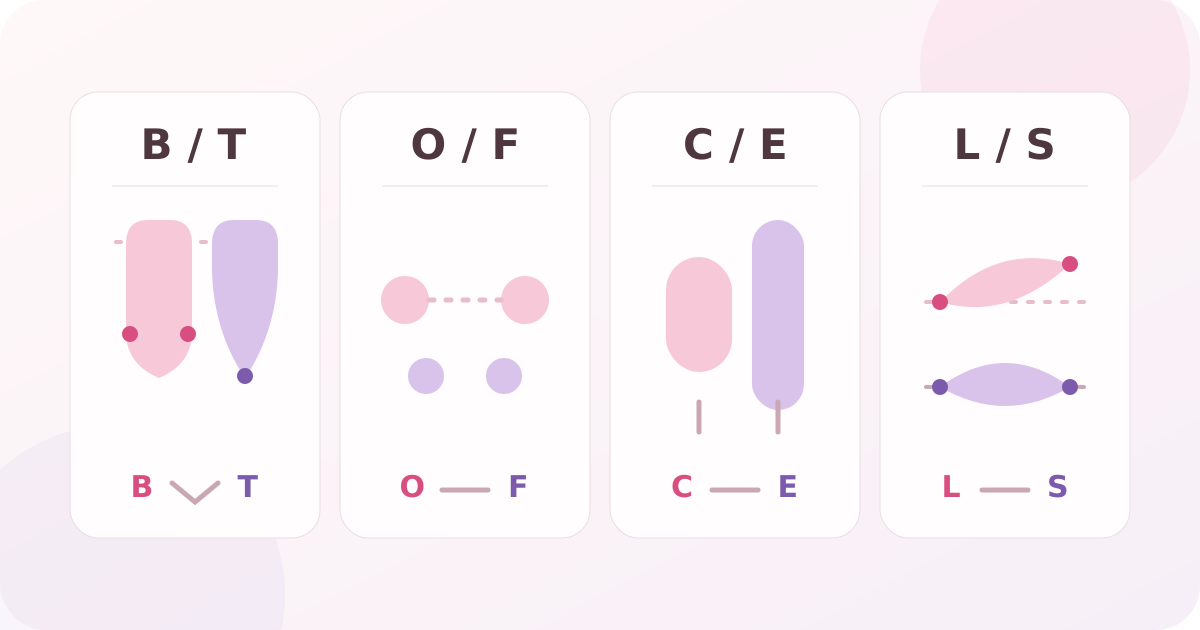
Four visual dimensions
| Position | Pair | Description |
|---|---|---|
| First | B Broad or T Tapered | The width retained by the lower face relative to the cheekbones and overall face: more width toward the jaw reads broader (B), while more narrowing toward the chin reads tapered (T). |
| Second | O Open or F Focused | The distance between the eyes relative to the eyes themselves: more space reads open (O), while less space reads focused (F). |
| Third | C Compact or E Elongated | The overall top-to-bottom proportions: a relatively shorter flow reads compact (C), while a relatively longer flow reads elongated (E). |
| Fourth | L Lifted or S Soft | The relative direction of the eye corners: a more upward direction reads lifted (L), while a softer, more level direction reads soft (S). |
Each pair is a neutral, relative description rather than a score or ranking. A letter only indicates which side of the pair is closer in the current photo.
Additional context
- B/T has nothing to do with weight. It compares how much width the lower face keeps relative to the cheekbones and overall face. It does not require the jaw and cheekbones to be the same width.
- O/F mainly reflects the space between the eyes. Their vertical openness may have a smaller supporting influence.
- C/E is about relative vertical proportions, not face size. The lower part of the face also adds a smaller supporting impression.
- L/S is mainly about the eye-corner direction, not the eyebrow shape. Brow curve adds a smaller supporting impression when it can be used.
A BOCL example
In a BOCL result, the four letters indicate:
- B: the lower face holds relatively more width, so the contour reads broad
- O: the eye spacing contributes a more open reading
- C: the top-to-bottom proportions read relatively compact
- L: the eye-corner direction reads relatively more lifted
Together, these four descriptions form BOCL. The animal name shown with a result is a visual nickname for identifying the combination. It does not correspond to thought, behaviour, social style, or emotion.
The letters do not indicate quality
The two sides of each FVTI pair represent different visual tendencies. No letter or combination is treated as a preferred result, and the code does not define beauty.
Photo variation and results
Camera angle, distance, expression, framing, hair, and facial visibility can all change the proportions and visual impression presented by a photo. Different images of the same person may therefore produce different results.
The label “closest match” means that the photo is nearer the middle of one or more pairs, so the result is expressed with greater caution. Another clear, front-facing photo may show a different tendency within the same pair.
An evenly lit, front-facing image with a natural expression and a fully visible face is generally more suitable when comparing results over time.
The scope of FVTI
FVTI is a photo-based description intended for entertainment and visual interpretation. It does not assess personality, identity, health, intelligence, compatibility, attractiveness, or personal value. The same four-letter result does not imply that two people share the same traits, nor does it provide a fixed definition of an individual.